Why Do Humpback Whales Go To Samaná?
Humpback whales travel to Samaná Bay each winter to mate and give birth in warm, shallow, protected water. Here is what the research and the sanctuary rules say about why, and how the tours are timed around it.
Humpback whales do not come to Samaná to feed. They arrive because the bay, and the wider Marine Mammal Sanctuary that surrounds it, gives them what a winter breeding ground needs: warm, shallow, calm water where a newborn calf can build strength and where mating activity concentrates year after year. The whales are in Dominican waters roughly mid-January through March, which is exactly why the licensed boats run then and not in summer. Every bookable departure here is scheduled inside that same window.
Humpbacks go to Samaná because the bay is a breeding and calving area: females give birth in the warm, protected water, males compete and sing for mates, and the shallow bay keeps calves close to the surface where they can breathe easily. The season runs mid-January through the end of March, timed by the environment ministry to the period when the whales are present. A long-running photo-identification effort has catalogued 252 individual humpbacks in the bay over time, which shows individual whales are identified in this bay over many seasons. To understand why warm, shallow water matters so much for a newborn calf, where whales give birth in Samaná Bay explains the science and what it means for your boat trip.
The basic biology explains the trip. Humpbacks spend the summer feeding in cold, food-rich northern waters, building fat reserves, and then fast through the winter breeding months. General humpback behavior is well documented in qualitative terms: mothers nurse their calves in warm water because a calf born in cold northern seas would struggle to build the blubber it needs, and males compete, escort and sing around receptive females. What Samaná offers specifically is a combination of depth, temperature and shelter. The bay is enclosed by a peninsula, the water stays warm through the winter months, and the seafloor is shallow enough that a calf can rest near its mother without deep diving.
The sanctuary is bigger than the bay itself. The Marine Mammal Sanctuary of the Banks of la Plata and la Navidad covers Samaná Bay plus two offshore banks, and the whole system is managed as one unit under the Ministry of Environment. The banks and the bay serve overlapping purposes: researchers describe the offshore banks as major concentration areas, while the bay functions as the accessible nursery and mating ground that the whale-watching boats are licensed to visit. A ministry-led expedition to Banco de la Navidad in early February 2026 recorded hundreds of sightings across three days, which is a survey of the offshore bank, not a count of the bay, and it shows how saturated the wider sanctuary is with whales at the exact time the tours run. To see how the bay fits into the bigger picture, the guide to humpback whales in the Dominican Republic explains where the whales gather across the sanctuary and how to see them from Punta Cana and Santo Domingo.
That concentration is why Samaná works as a whale-watching destination at all. The whales are not distributed evenly along the Dominican coast. They gather in a predictable place at a predictable time, which makes responsible viewing possible: the ministry can license boats, CEBSE can enforce observation distances, and visitors can plan a trip around a real window rather than a lucky gamble. If you want the fuller picture of that window, the best time for whale watching guide breaks down the season month by month.
What Makes Samaná Bay A Nursery?
The bay's value as a nursery comes from warmth, shelter and shallow depth: a calf born here can nurse and grow in water that stays mild through the winter, with little of the wave energy and cold upwelling that open ocean exposes a newborn to. Mothers with calves are the group the boat rules protect most strictly, at 80 meters rather than the 50 meters that applies to any other whale group, precisely because mother-calf pairs are the reason the whales come. Anything that separates a mother from a nursing calf, or forces them to flee, costs energy the calf cannot spare.
A humpback calf is born big but not ready. It has to nurse intensively, learn to breathe efficiently, and build the muscle and fat for a long migration before the season ends, all within weeks. Warm water reduces the energy a small calf burns simply staying warm, which is the core reason humpbacks as a species migrate to tropical breeding grounds rather than calving where they feed. Shelter matters just as much. Samaná Bay is ringed by land on most sides, so wind chop and swell are limited compared with the open Atlantic side of the peninsula, and a calf can rest at the surface in conditions that let it breathe without effort.
The behavior visitors most hope for follows from the nursery function. Calves stay close to their mothers in the first weeks, and researchers describe the bay through February as a mix of calving and mating activity, with escorts, competing males and singing males all present at once. A mother with a young calf may rest near the surface for long stretches, which is why patient boats that keep their distance often get longer, calmer encounters than boats that crowd in. That is not operator folklore; it is the logic behind the observation-time limits in the sanctuary rules, which we cover further down.
What the whales are doing in the bay, and when, is best summarized as a progression rather than a single event:
| Period | What researchers and operators describe in the bay |
|---|---|
| Mid-January | Season opens; arrivals build as the licensed boats begin running |
| Late January into February | Mating and calving activity reported in the bay; competing males and mother-calf pairs both present |
| February to early March | Researchers describe the highest concentrations of the season |
| Mid to late March | Activity tapers; the season runs to the end of March with no hard last day printed |
The takeaway for planning: February is the month the whole system is at its busiest, but it is also the month with the most boats and visitors on the water. Early in the season you may share the bay with fewer people; late in the season the crowds thin before the whales do.
Why Is The Season January To March?
The season is set by the whales' own cycle: they arrive in Dominican waters in midwinter, breed and calve through February, and leave as the water warms, so the ministry licenses boats only from mid-January through the end of March. In 2026 that meant 46 environmental authorizations, 43 for Samaná operations and 3 dispatched from Puerto Plata, processed digitally for the first time. The dates are not a commercial choice dressed up as conservation; they are the management tool that keeps boats off the water when the whales are not there to be watched.
The 2026 season opened officially on 15 January under an inter-institutional management agreement signed by the Ministry of Environment, which also created a Marine Mammal Sanctuary Management Committee responsible for planning, boat inspections, captain training, scientific monitoring and end-of-season technical reports. That structure, announced with the ministry's own season opening release, is the machinery behind the calendar: the season exists because a committee of ministry and sanctuary bodies agrees the window each year and licenses boats inside it.
For 2027 the dates have not been announced, but the ministry's permit call ran 16 October to 13 November 2026, so the boats that will carry visitors in early 2027 are being licensed months before anyone knows the exact season dates, which is normal: the window has held at mid-January to late March, with the standing pattern described across the sanctuary and season overview.
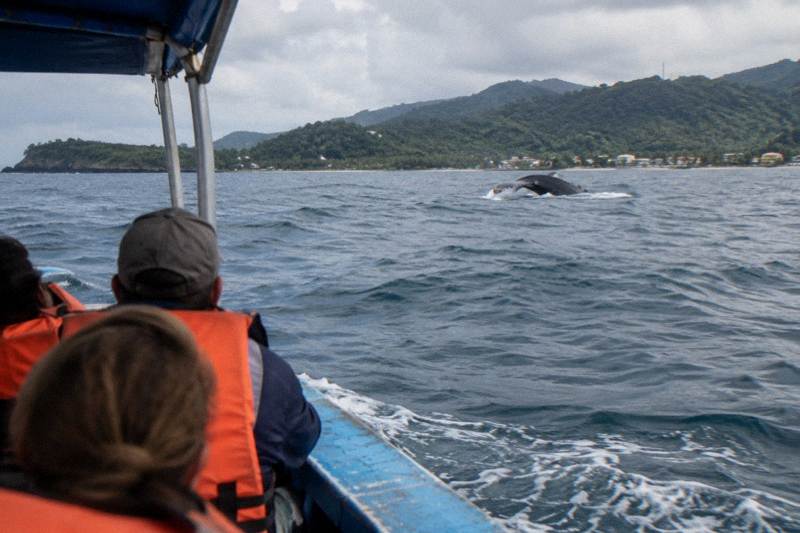
One practical note follows from all this: any operator selling whale watching in Samaná outside roughly mid-January to late March is selling something the licensing system does not cover. Every departure listed here, from the budget 6 to 7 hour tour with snacks at from $45 per person to the whale and Cayo Levantado full day at from $84 per person, runs inside the licensed window. If a deal advertises Samaná whales in November or December, read the fine print before paying anything.
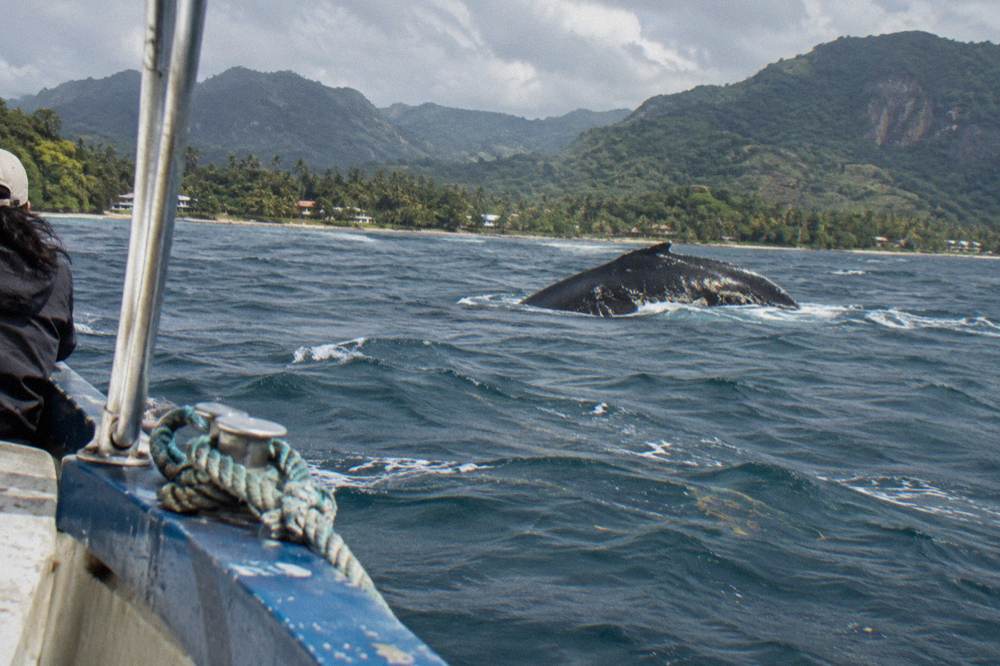
What Do The Whales Actually Do In The Bay?
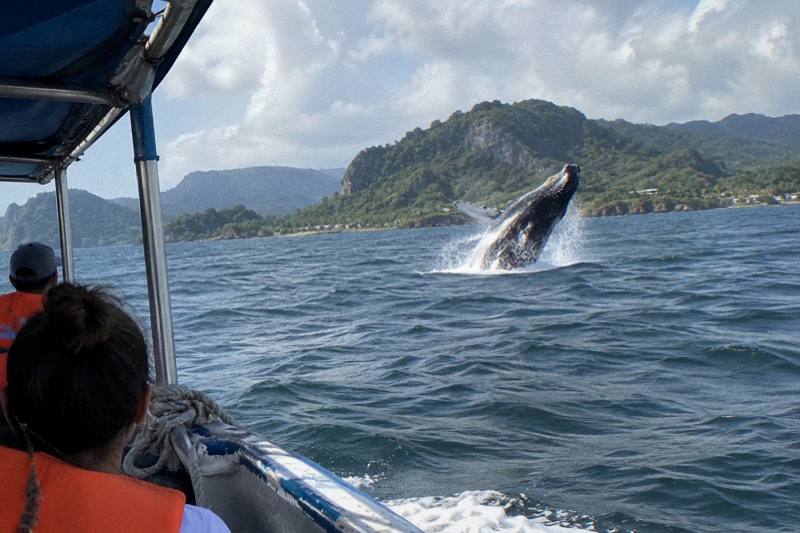
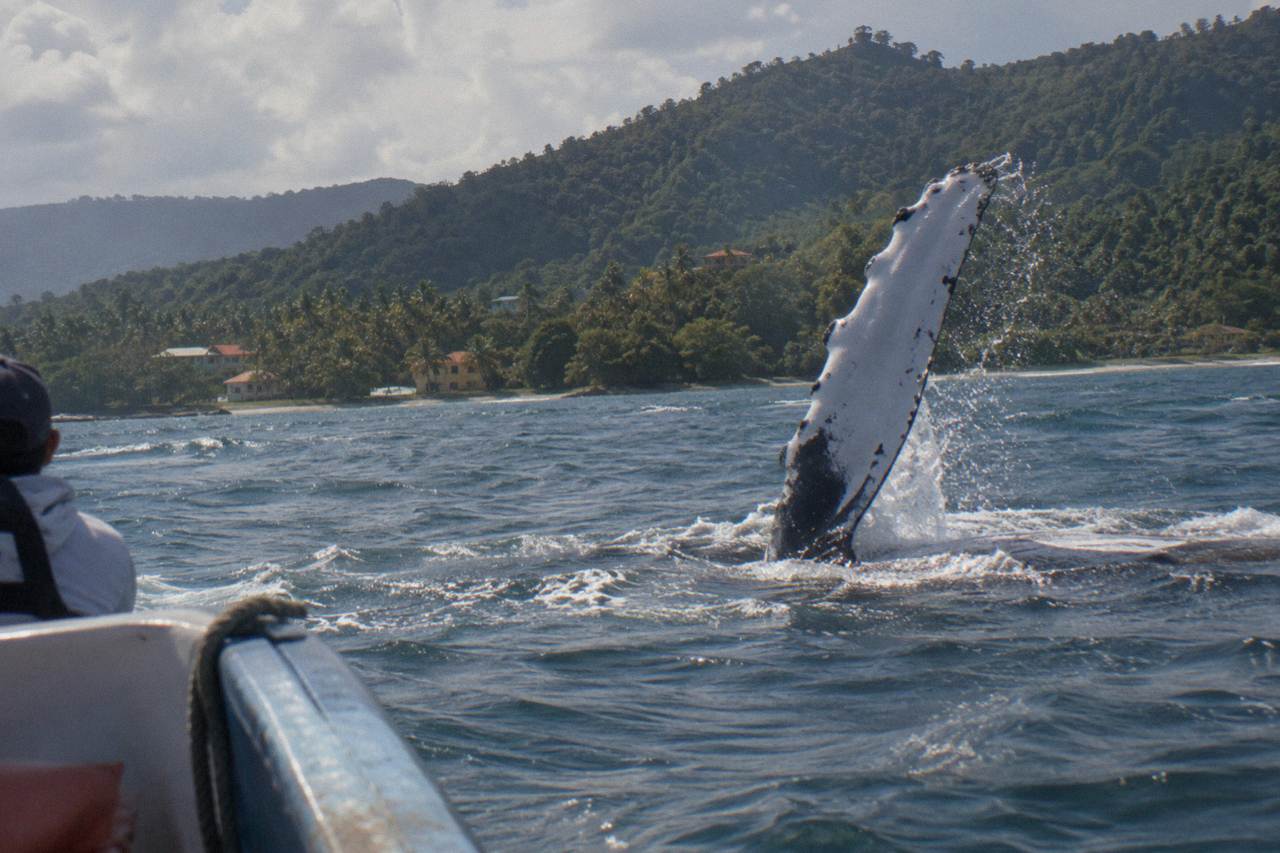
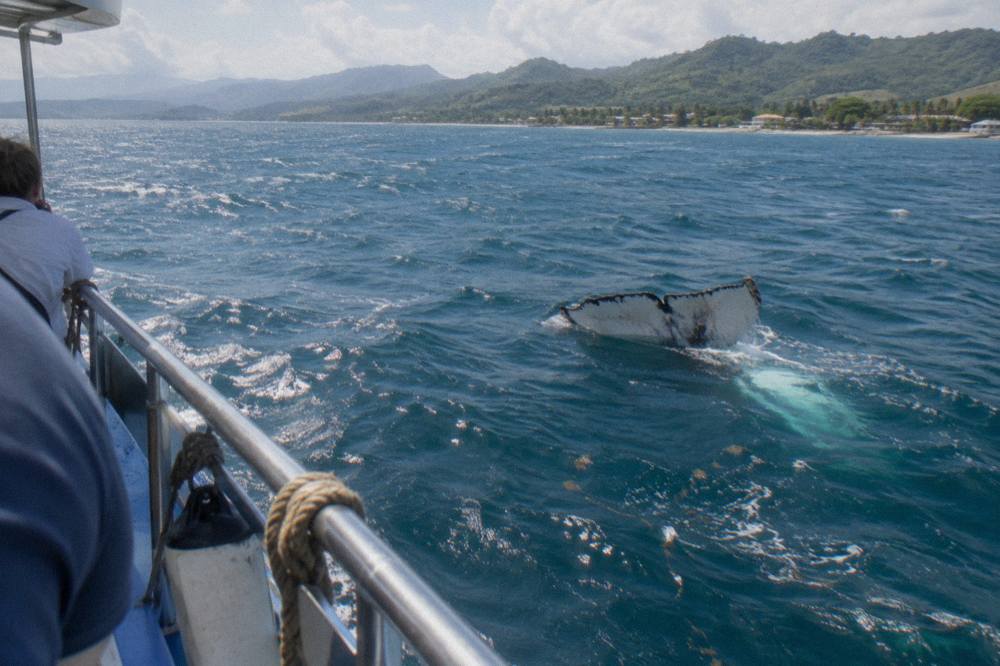
The bay serves two overlapping purposes: mothers give birth and nurse their calves, while males compete for and escort females. Much of the surface behavior visitors hope to see from the boats, including breaching, tail slapping, and fin slapping, comes from these activities. Qualitatively, these behaviors are well documented and commonly reported from Samaná, though no operator can promise any of them on a given trip; sea state, weather and whale mood all vary. What the rules can promise is that licensed boats keep a distance that lets the whales keep behaving naturally rather than fleeing.
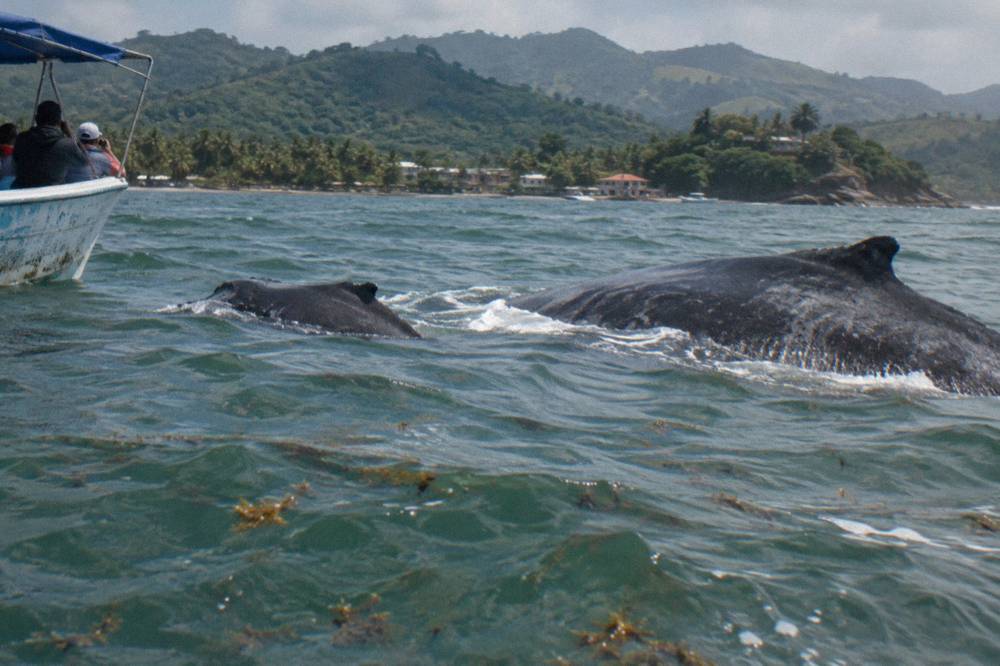
Mother-calf pairs are the quiet heart of the season. A calf nurses on milk that is extremely rich in fat, grows quickly, and spends much of its time within a body length of its mother, rising to breathe in a coordinated rhythm. Rest is a large part of early life, and a resting pair at the surface is one of the more common and most rewarding sights from a patient boat. The 80-meter distance rule for mothers with calves exists for exactly this configuration: a boat that pushes closer forces a mother to choose between her rest and her calf's safety, and the sanctuary's rules remove that choice from the equation.
The mating side is louder. Male humpbacks compete around receptive females, and that competition can mean escorts swimming tight to a female, males physically challenging each other, and high-energy surface activity. Breaching, lobtailing and fin slapping are all commonly reported in the bay, and researchers link vigorous surface behavior to this social competition and to communication between whales, though the full function of a breach is still debated in general humpback science. Singing is part of the same picture; humpback song is a male breeding-season behavior studied across the species, and while a day-trip visitor will not hear it without hydrophones, it is part of what the males in the bay are doing while the boats circle at a distance.
None of this comes with a timetable. A three-hour trip can produce a distant fluke and a long wait, or a full hour of surface activity close to the observation limit; the what to expect on the boat guide covers the realistic shape of a day on the water. What the biology does tell you is that the behaviors are seasonal and social, so the best odds of seeing social activity are the same weeks researchers describe as peak concentration, February to early March, and that patience beats positioning.
How Do The Boat Rules Protect The Calves?
The sanctuary's boat rules, applied by CEBSE since 1996 and licensed by the Ministry of Environment, keep watching sustainable: 80 meters from mothers with calves, 50 meters from any other group, at most three boats per group with a fourth waiting 250 meters away, and a 30-minute maximum observation time when boats are queuing, halved when whales are scarce. Engines must stay on in the observation area, swimming with whales is prohibited in Samaná Bay, and drones are not allowed without ministry permission. Every rule maps onto the nursery biology described above.
The CEBSE panel on Samaná Bay is the primary published source for these rules, and 2026 added enforcement tools on top of them: a voluntary GPS pilot using the Earth Ranger platform ran on licensed boats for real-time tracking during the season, coordinated with the Dominican navy, and press reporting on the 2026 season noted that illegal swimming offers from Las Galeras and unauthorized drone flights remain enforcement problems. This is why checking that your boat is licensed matters as much as checking its price: a licensed operator has been through inspection and captain training under the management committee, and an unlicensed one has not.
For a visitor, the practical translation is simple. Choose licensed departures, expect the boat to hold its distance rather than chase whales, and treat a captain who follows the rules as a feature, not a disappointment. A distant mother and calf left undisturbed for 30 minutes will often reward the whole viewing area with relaxed, natural behavior. For more on the framework, the humpback whales in the Dominican Republic guide covers the sanctuary in depth.
Can You See This Behavior On A Tour?
Yes, within the limits of weather and whale behavior: licensed tours put you inside the sanctuary during the weeks when calving and mating activity is happening, and commonly reported sights include mother-calf pairs, breaching, and tail slapping, though no operator can promise a sighting or a behavior. The featured whale watching and Cayo Levantado full day, from $84 per person and rated 4.7 from 224 reviews, runs about 7 hours with a buffet lunch on Bacardi Island, a guide, snacks and drinks; Check availability if the full-day shape fits your plans.
The lineup spans a wide range of formats and prices, and comparing a few side by side shows how much choice there is once you are in town:
| Tour (Samaná departures) | Price | Duration | Rating |
|---|---|---|---|
| Whale Watching Tour with Snacks | from $45 per person | 6 to 7 hours | 4.9 from 20 reviews |
| Bay of Samana Whale Watching Experience | from $69 per person | 3 hours | 4.5 from 126 reviews |
| Whale Watching and Cayo Levantado Full Day Tour | from $84 per person | 7 hours | 4.7 from 224 reviews |
| Half-Day Humpback Whale Watching | from $95 per person | 3 to 6 hours | 3.5 from 15 reviews |
The short bay cruise, from $69 per person and rated 4.5 from 126 reviews, is the focused option: three hours on the water with a guide, coconut snacks and drinks, no island stop, no meal, a pure whale trip. It suits a visitor who wants the sanctuary experience without committing a full day, and it leaves from Avenida La Marina in Samaná town, the same dock area most departures use.
The half-day humpback trip, from $95 per person and rated 3.5 from 15 reviews, runs 3 to 6 hours depending on the option and includes a guide, snacks, life jackets and entry tickets, meeting at Restaurant Royal Samaná. With 15 reviews the pool is small, so read the recent feedback yourself on the listing rather than treating the number as settled verdict. Different listings are genuinely different products: inclusions, pickup and duration belong to the specific listing, and the cost comparison guide breaks the lineup down by departure point and price.
And the budget fare with snacks, from $45 per person and rated 4.9 from 20 reviews, is the cheapest boat listed here; 20 reviews is a modest pool, but the rating is strong for the price, and the listing includes coconut snacks, water and soft drinks, a boat ride and an expert guide. Whichever format you choose, the underlying experience is the same sanctuary, the same rules and the same whales, doing what they came to Samaná to do.
Common Questions About Why Whales Go To Samaná
When is the best time to see whales in Samaná Bay?
Researchers describe the highest concentrations as February to early March, with mating and calving activity reported in the bay through February. The season runs mid-January to the end of March. No month-by-month sighting counts exist, and no operator can promise a sighting.
Do the whales feed in Samaná Bay?
No, the winter visit is not about food. Humpbacks build fat reserves in cold northern feeding waters in summer and generally fast through the breeding season, living off those reserves while they mate, give birth and nurse in the warm tropical water.
How many whales visit Samaná Bay?
A long-running photo-identification effort has catalogued 252 individual humpbacks in the bay over time. No full season-wide count is published for the bay itself, and the large expedition figures come from surveys of the offshore Banco de la Navidad, not the bay.
Is swimming with whales allowed in Samaná Bay?
No. Swimming with whales is prohibited in Samaná Bay under the sanctuary rules; it is allowed only at Banco de la Plata under strict permits on authorized live-aboards. Offers to swim with whales from Las Galeras are illegal.
Why do the boats only run from January to March?
Because the licensing system, run by the Ministry of Environment, only authorizes whale-watching boats for the window when the whales are present: mid-January through the end of March. In 2026 that meant 46 environmental authorizations. Dates for 2027 have not been announced.