Can You Touch A Whale If It Swims Up To You In Samaná Bay?
The CEBSE rules for Samaná Bay set 80 meter and 50 meter distances, keep engines on and ban swimming with whales. Here is what that means if a humpback approaches your boat.
No, you cannot touch a whale in Samaná Bay, even one that swims right up to your boat. CEBSE rules require licensed operators to keep 80 meters from mothers with calves and 50 meters from other groups, ban swimming with whales entirely, and keep engines running near the animals, so a curious whale creates no exception.
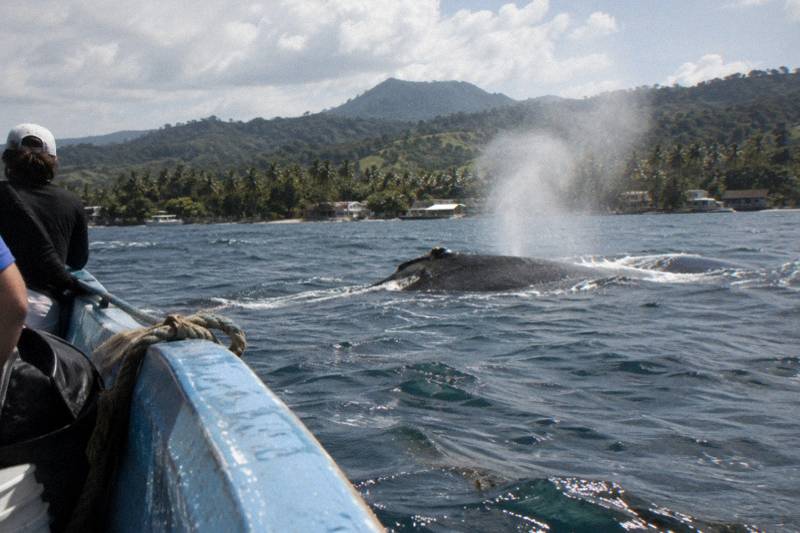
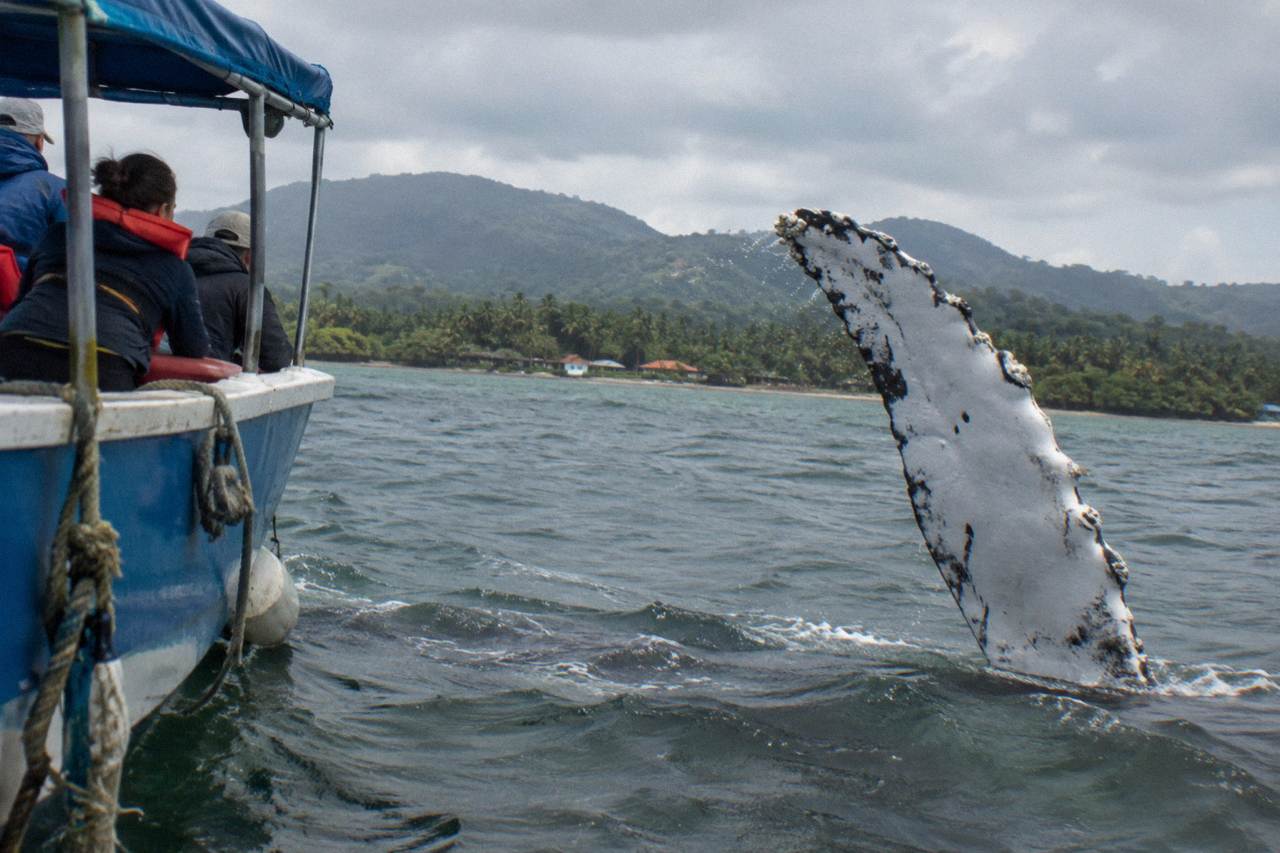
The question sounds hypothetical until you are standing at the rail. Humpbacks in the bay in January are mothers with newborn calves, and males trailing females, and the occasional juvenile that seems as interested in the boats as the boats are in it. A whale surfacing near a vessel, a flipper rising a few meters from the hull, is exactly the moment people reach for their phone and then, sometimes, wonder about their hand.
The answer from the sanctuary's own framework is unambiguous. CEBSE, the Centro para la Conservación y Ecodesarrollo de la Bahía de Samaná, has applied whale watching regulations in the bay since 1996, licensed through the Ministry of Environment, and those rules describe how boats approach whales, how long they stay, and what is forbidden. Touching, feeding and entering the water are not part of any lawful Samaná Bay trip. Operators who market anything else, and swimming offers from Las Galeras in particular have been reported, are operating outside the rules.
That matters for how you choose a tour. The licensed departures from the Samaná town dock, like the 3-hour Bay of Samaná whale watching experience from $69 per person, are built around watching from the boat under the rules, not around proximity or contact. Longer days, like the whale watching and Cayo Levantado full day tour from $84 per person, add the island stop but keep the same whale protocol on the water. A private option such as the Miches private whale watching trip from $95 per person changes the group size, never the distance rules.
What The Sanctuary Rules Actually Say
The CEBSE framework sets four working limits: 80 meters from a mother with a calf, 50 meters from any other whale group, at most three boats per group with a fourth waiting 250 meters away, and a maximum of 30 minutes of observation per group when other boats are queuing, halved when whales are scarce. Engines must stay on in the observation area, swimming with whales is banned in the bay, and drones may not fly without ministry permission.
Reading the rules as a visitor, the striking thing is that they regulate boats rather than passengers. The distances are navigation distances, held by the captain, not a rope line you stand behind. The time limit exists so that a popular whale group is not surrounded all afternoon: when three boats are watching, any fourth vessel holds station 250 meters off and waits up to 30 minutes for one to leave. When whales are scarce, the 30-minute cap drops to 15 so the animals get relief sooner.
| Rule | What it means on the water |
|---|---|
| 80 m from mothers with calves | Boats hold the greatest distance from the most sensitive groups, and calves are common in the bay |
| 50 m from any other group | The standard observation distance for single whales and adult groups |
| 3 boats maximum per group | A fourth boat waits 250 m away, up to 30 minutes, until one departs |
| 30 minutes maximum per group | Cut to 15 minutes when whales are scarce, so pressure on one group is limited |
| Engines stay on | A boat never drifts engineless beside whales, for safety and maneuverability |
| No swimming with whales | Applies to the whole of Samaná Bay, regardless of who offers it |
| No drones | Flights inside the sanctuary need ministry permission |
The rules are not voluntary guidelines. In 2026 the Ministry of Environment issued 46 environmental authorizations for the season, 43 for Samaná operations and 3 dispatched from Puerto Plata, processed digitally for the first time, and signed an inter-institutional management agreement that creates a sanctuary management committee covering vessel inspections, captain training and monitoring. A press report on the 2026 season describes a GPS pilot on licensed boats, on the Earth Ranger platform, for real-time tracking coordinated with the Dominican navy. The licensed fleet, in other words, is watched while it watches whales.
Why The Boats Keep Their Engines On
Engines stay on because maneuverability is the safety system. A licensed boat holding 50 or 80 meters from a whale group needs to be able to respond the moment an animal changes course, and a boat with engines running can shift position or hold station immediately. The rule exists on the whale's side of the ledger too: it prevents boats from sitting silently among animals that have not noticed them.
Think of it as the maritime equivalent of keeping a car in gear on a hill. The observation area is a shared space with other vessels, waiting boats 250 meters out, and whales that surface without warning. A captain whose engines are live can back off, turn, or hold a steady distance, and the CEBSE framework treats that capability as part of how the sanctuary protects the animals.
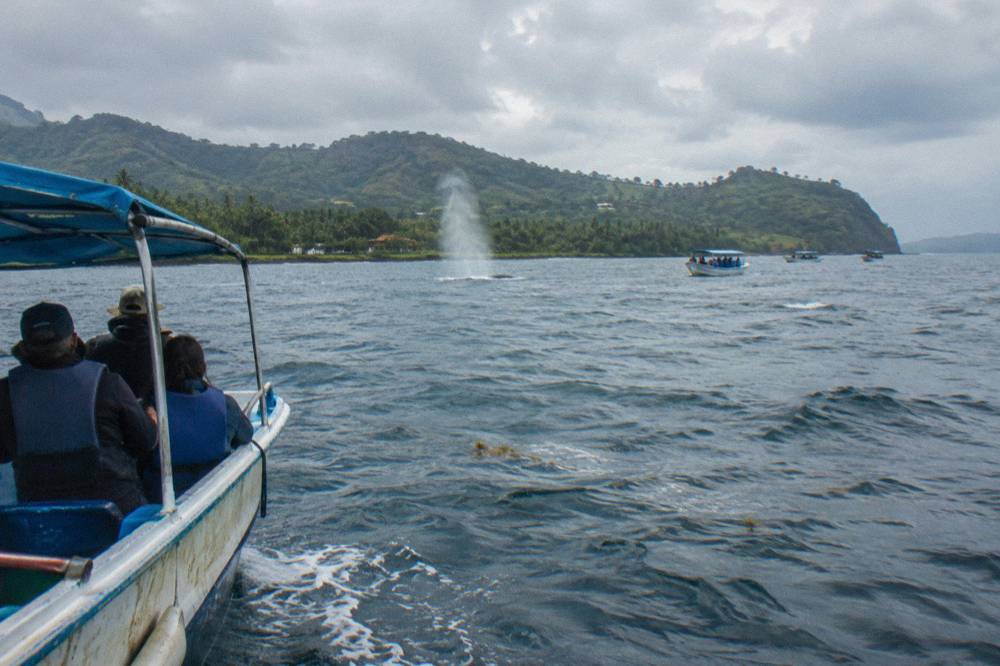
For a passenger, the practical reading is simple: nothing about your trip requires you to do anything except watch, photograph and listen to the guide. The standard bay trips run around three hours on the water, and the tours listed here range from a 3-hour short bay cruise to full 10-to-13-hour days from Punta Cana that pair whales with Cayo Levantado, known on the listings as Bacardi Island, or with the El Limón waterfall. The whale-watching portion of every one of them happens from the deck.
That is also why the question "can you touch a whale if it swims up to you" has a firm no even in the friendliest scenario. If a whale approaches the boat, the boat's job under the rules is to be predictable and idle in behavior while remaining under power.
Is Swimming With Whales Legal Anywhere In The Dominican Republic?
Yes, in one place: Banco de la Plata, the Silver Bank, roughly US$3,500 to 5,500 for a week. In Samaná Bay, no. Swimming with whales is prohibited throughout the bay, and offers of swim contact sold from Las Galeras are illegal.
That distinction is worth understanding because it explains the shape of the market. The Dominican Republic's marine mammal sanctuary spans the Banks of la Plata and Navidad as well as Samaná Bay, and the in-water encounters the travel press writes about happen on the bank, not in the bay, under a permitting regime reserved for a handful of authorized live-aboard operators. The 2026 season's 46 authorizations included 3 dispatched from Puerto Plata that belong to those live-aboard operations. Other pages covering the same trip are gathered on Whale Tours Samana.
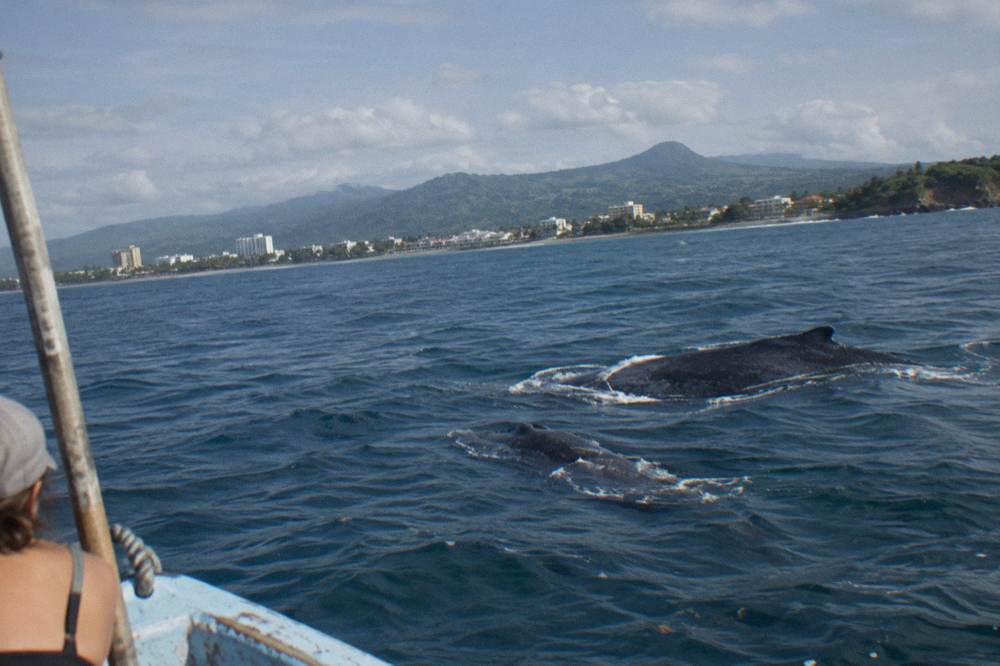
Nothing listed here from Samaná, Las Terrenas, Punta Cana or Santo Domingo offers, or could lawfully offer, an in-water encounter. If a listing you find elsewhere promises swimming with whales in Samaná Bay, it is promising something the sanctuary framework does not permit, and the enforcement reporting from the 2026 season flags exactly such offers as a compliance problem. The honest version of a Samaná whale day is a boat day: rail, guide, binoculars, camera, and a whale protocol designed for the animals' breeding season.
The trade is a real one. Banco de la Plata trips mean a week at sea and a four-figure budget. A Samaná Bay day means from $45 per person at the cheapest end of the tours listed here, from $69 for the 3-hour bay cruise, from $84 for the featured whale and Cayo Levantado full day, and from $95 for a private trip out of Miches. Different products entirely, and only one of them is a realistic day trip.
Whale Watching From Samaná And Las Terrenas · 3 - 6 hours
1 review so far · From $95
Check availability →What A Close Approach Actually Looks Like From The Deck
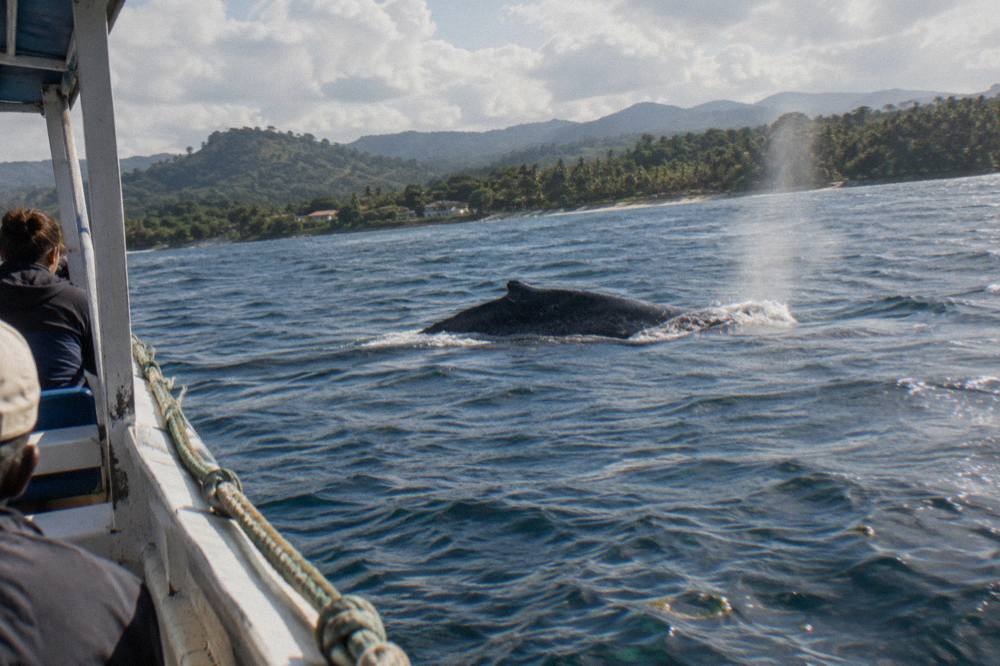
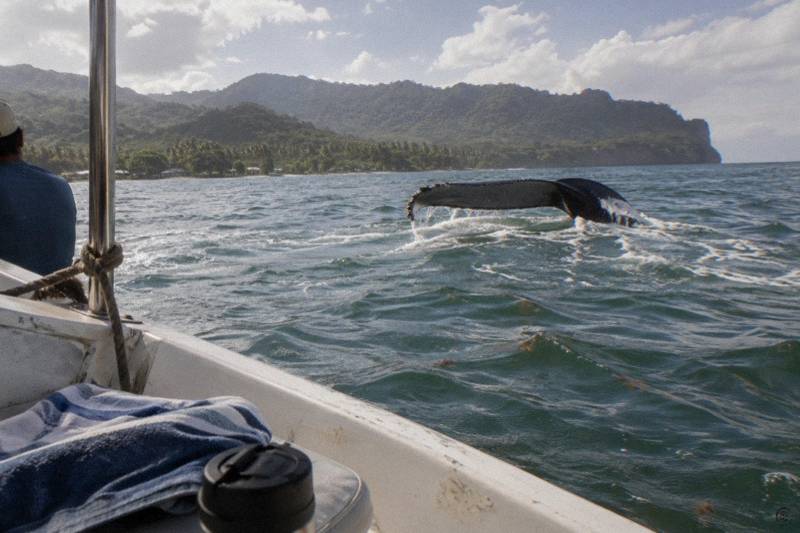
When a whale surfaces near a licensed boat, the crew's obligations stay the same: keep the permitted distance where possible, keep engines on, respect the time cap, and let the animal control the encounter. Guests stay aboard, hands and cameras inside the rail, and the guide narrates what the whale is doing. No source describes a formal protocol for whale-initiated approaches, so anything beyond that is operator judgment within the rules, not a published procedure.
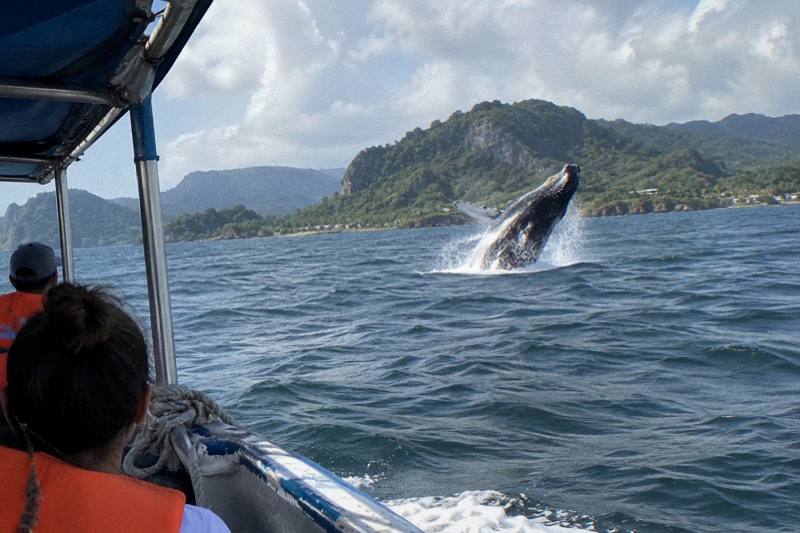
Humpbacks are curious animals, and general behavior can be described qualitatively: they surface to breathe, mothers keep calves close, and males in the breeding season are active and sometimes acrobatic. What no honest operator or writer can promise is a specific behavior on a specific trip. Sea state, weather and the whales themselves vary day to day, which is why no sighting rate is printed, and why the distance rules are designed to protect animals whether they are interested in boats or indifferent to them.
For photographers, the rules are actually a gift. A boat holding 50 meters in calm morning water, which is when Samaná Bay is often at its calmest before the afternoon trade winds freshen things up, gives you a stable platform and a predictable subject. A whale that chooses to pass closer does so on its own terms, and those moments, a fluke lift at mid-distance, a calf surfacing under its mother's chin, are the images that last.
If you are weighing which departure gives you the steadiest platform, the practical pages go deeper: what to expect on a Samaná whale watching boat covers the flow of a typical trip, and seasickness on Samaná whale watching boats addresses the condition most likely to color your morning, and none of it involves contact with anything but the rail.
Drones, Feeding And Other Common Mistakes
Three things trip up well-meaning visitors: drones, which may not be flown inside the sanctuary without ministry permission; reaching toward whales, which the distance and no-swimming rules effectively prohibit; and feeding or chumming, which no licensed Samaná operator does. All three are treated as pressure on animals that are in the bay to breed and calve, not to entertain.
The drone rule is the one people genuinely do not know. Launching a small camera drone from a whale boat to get aerial footage of a mother and calf is not a gray area, it requires ministry permission, and unauthorized flights near whales have been reported during recent seasons, which is part of why enforcement attention has grown. One Punta Cana listing, the Bacardi Island day from $169 per person, lists professional photos and videos among its exclusions.
| Temptation on the water | What the rules say | The legal alternative |
|---|---|---|
| Reaching a hand toward a surfacing whale | Distances and the no-swimming rule govern contact; boats hold 50 to 80 m | Watch and photograph from the rail |
| Jumping in for a selfie | Swimming with whales is banned in all of Samaná Bay | In-water encounters exist only at Banco de la Plata, week-long live-aboard |
| Flying a drone from the deck | Not allowed without ministry permission | Buy the operator's professional photo package where offered |
| Feeding or chumming to attract whales | Not part of any licensed operation | None; the whales are in the bay on their own schedule |
| Asking a captain to close the distance | Time and distance caps bind the operator's licence | Pick a small-boat or private listing for intimacy of group, not of contact |
The last row is where buyer expectations meet the rules. People sometimes book a private trip believing privacy buys proximity. It does not. The private whale watching option from Miches, from $95 per person, gives you a captain and guide dedicated to your group and an optional Cayo Levantado stop, and it operates under the same 50-meter and 80-meter limits as a 60-passenger departure. What changes is the crowd on your boat, never the whale's margin.
This is worth internalizing before you compare listings, because marketing language can blur it. A listing that emphasizes "up close" experiences is describing whale watching from a boat at regulation distance, and reputable operators are fine saying so. A listing that implies touch or swim contact in Samaná Bay is either careless with words or careless with the law, and either way it is a signal to keep shopping.
How The Rules Shape The Tour You Actually Book
Every tour listed here is a boat-based, rules-bound whale watch: shared departures from $45 to $210 per person depending on origin and length, private options from $95, and combo days adding Cayo Levantado or the El Limón waterfall. Knowing the rules before you book tells you which questions matter, and none of them is "how close do we get," because the sanctuary answers that one for everyone.
The questions that do matter are the ones the lineup can answer. Where does the boat depart: the Samaná town dock on Avenida La Marina for the bay cruises, the Whale Samana office on Calle Mella for the 7-hour trip, a Las Terrenas meeting point for the 6-hour departure from $125 per person, or hotel pickup across Punta Cana and Bávaro for the long day trips. How long: 3 hours for the short bay cruise up to 13 hours for the whales-and-waterfall combo from Punta Cana, rated 4.5 from 146 reviews.
| Tour type listed here | Price range | What it offers beside the whales |
|---|---|---|
| Short bay cruise, 3 hours, Samaná | from $69 per person | Snacks, drinks, guide, no meal |
| Whale and Cayo Levantado full day, Samaná | from $84 per person | Buffet lunch on the island, rated 4.7 from 224 reviews |
| Private trip from Miches | from $95 per person | Private boat, captain and guide, optional island stop |
| Las Terrenas departure, 6 hours | from $125 per person | Las Terrenas meeting point, lunch, guide |
| Punta Cana day trips | from $110 to $200 per person | Hotel pickup, meals on most listings, island stops |
| Combo days with El Limón waterfall | from $110 to $199 per person | Waterfall visit, horseback on some listings, lunch |
The 3-hour Bay of Samaná whale watching experience is the purest version of watching whales the way the sanctuary intends, from a boat, at distance, with a guide who explains what you are seeing, and at from $69 per person with a 4.5 rating across 126 reviews it does not gamble your budget on extras. The cruise departs from Av. La Marina 3 in Samaná town, includes local snacks, water and soft drinks, and states plainly that a buffet lunch is not included. If you want the island too, the whale and Cayo Levantado full day from $84 per person, 4.7 from 224 reviews, is the fuller day at a small premium.
For readers planning around the season, the window runs mid-January through March, with the 2026 season having run 15 January to 31 March under the ministry's opening, and researchers describe peak concentrations from February into early March. The ministry's own season announcement has dates and permits. Details on timing are covered in full in the best time for whale watching in Samaná.
Common Questions About Touching Whales In Samaná Bay
Has anyone ever legally swum with humpbacks in the Dominican Republic?
Yes, at Banco de la Plata, the Silver Bank, which lies within the same marine mammal sanctuary but far offshore. Swimming there is permitted only under strict permits held by a small number of live-aboard operators, with week-long trips roughly US$3,500 to 5,500 per person. Samaná Bay day trips never include in-water encounters.
Why do the boats keep their engines running near the whales?
Maneuverability. A boat with engines live can respond instantly if a whale changes course, hold its station, or give way. CEBSE's framework requires engines to stay on in the observation area for exactly this reason, for the safety of the whales and everyone aboard.
Can I fly a drone from the whale boat to film?
No. Drones may not be flown inside the sanctuary without ministry permission, and unauthorized flights near whales have been reported. Some listings sell professional photo and video packages as an extra, which is the legal route to keepsake footage.
Do the distance rules mean I will barely see the whales?
No licensed operator can promise what you will see. That said, 50 meters is close enough for fluke lifts, breaches and mother-and-calf pairs to fill a camera frame, and humpbacks regularly surface and breathe at ranges that feel far nearer than the number suggests.
What should I do if someone offers me a swim with whales from Las Galeras?
Decline. Swimming with whales is prohibited in all of Samaná Bay, and such offers have been reported in enforcement coverage of recent seasons. Book a licensed boat departure instead, and read the cancellation terms on the listing before you pay.
The short version, before you book anything: the sanctuary's answer to the touch question is no, and the no is the same whether you are on a 3-hour bay cruise, a private Miches departure or a 13-hour Punta Cana combo.